

Futures Forced Liquidation FAQ
2024-04-23 08:48:40
KCEX Exchange focuses on providing USDT- and USDC-margined perpetual futures, offering futures trading enthusiasts leverage of up to 125x, allowing investors to amplify potential returns. However, high-leverage trading also comes with corresponding risks, including the possibility of liquidation. To help you better understand and manage these risks, this announcement will provide a detailed introduction to the liquidation mechanism in futures trading, helping you trade futures more effectively.
1. Using Mark Price to Execute Liquidation
In KCEX's futures trading, we utilize the "Mark Price" to determine whether to trigger forced liquidation. The Mark Price is calculated based on a combination of the index price and market price, offering a fair and reasonable price assessment. This pricing method helps prevent unnecessary liquidations that might occur due to market volatility or liquidity shortages.
By using the Mark Price, you can effectively avoid forced liquidations caused by insufficient liquidity or market manipulations. When the Mark Price reaches the liquidation price, liquidation will be triggered.
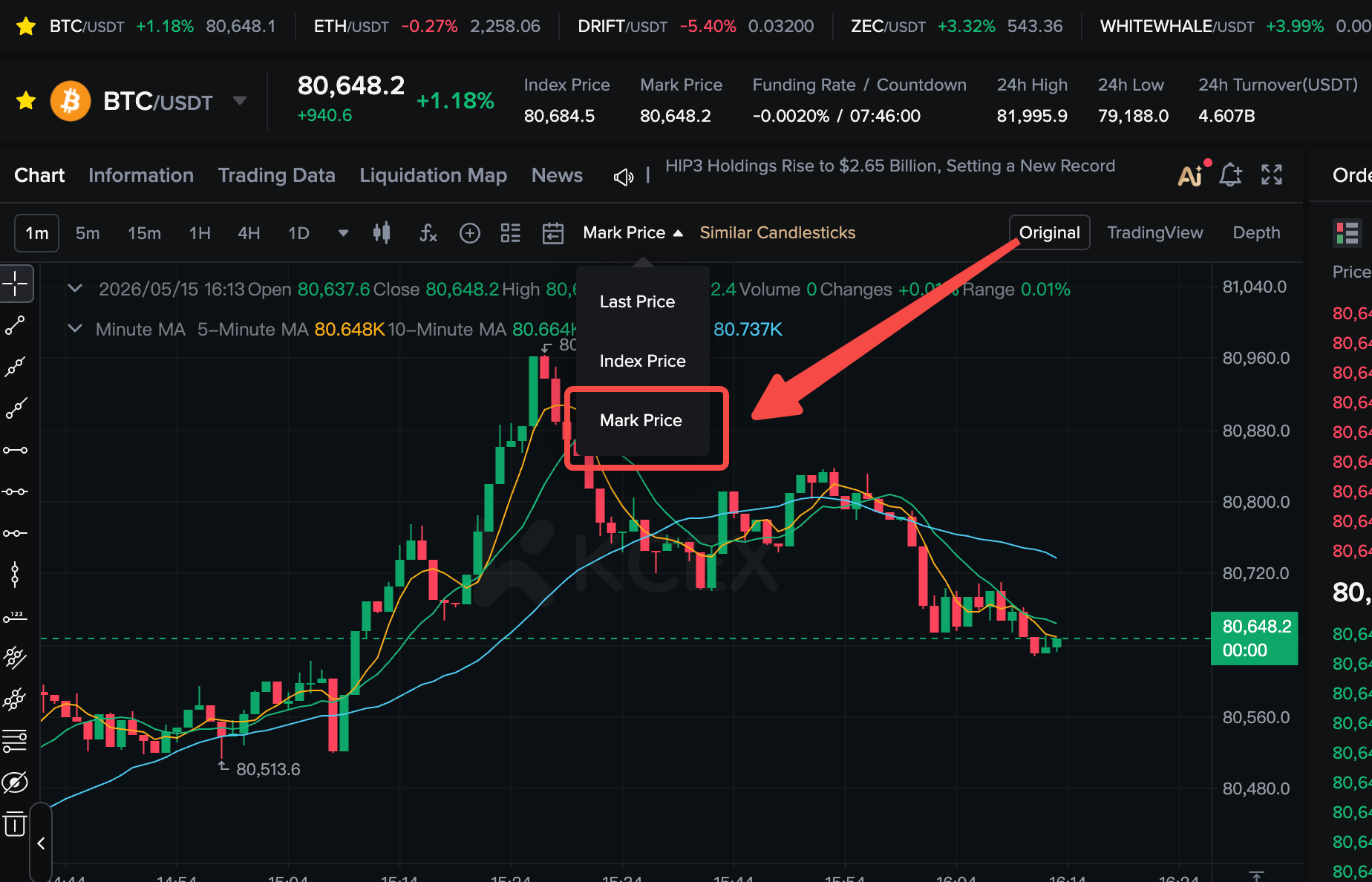
You can view the Mark Price on the KCEX website by selecting the [Mark Price] option above the K-line chart, allowing you to monitor your contract positions and market conditions more effectively.
2. Bankruptcy Price Takeover
When a user triggers liquidation, KCEX will liquidate positions through various methods such as order cancellation, tiered liquidation, and long-short self-trading. A bankruptcy price takeover occurs when the risk limit tier of a user’s position exceeds a certain threshold, prompting the system to automatically liquidate part of the position to reduce risk levels. If, after down-tiering, the position still meets the liquidation criteria, it will be taken over by the liquidation engine at the bankruptcy price.
3. Changes to the Liquidation Price
The liquidation price of futures positions differs under Cross Margin and Isolated Margin modes. In Cross Margin mode, all available margin will be used as position margin. If you hold multiple positions, unrealized PNL will affect your liquidation price. When your unrealized PNL increases, your position is less likely to be liquidated; when your unrealized PNL decreases, your position is more likely to be liquidated. In addition, under Cross Margin mode, the liquidation price will also change if the position size changes. In Cross Margin mode, you can monitor the margin ratio. Under Isolated Margin mode, if the opening price remains unchanged, no additional position is opened, and no extra position margin is added, the liquidation price will remain unchanged. When the margin ratio reaches 100%, it means that part of your held position may be taken over by the liquidation engine at the bankruptcy price.
Funding rates can also impact the liquidation price. In cross margin mode, the accumulation or payment of funding fees will alter the margin amount, thus changing the liquidation price. In isolated margin mode, if funding fees are paid and there is insufficient available margin, position margin will be deducted, affecting the liquidation price.
4. Failed Stop-Loss Orders
While trading futures on KCEX, you might encounter situations where your stop-loss (SL) orders fail, which can be caused by:
1. Unreasonable SL Price Settings: If the SL price is set too close to the liquidation price, it might trigger forced liquidation before the SL order can activate, causing the order to fail.
2. Severe Market Fluctuations: In times of intense market volatility, market prices may rapidly surpass the set SL price, leading to unexecuted or partially executed orders.
3. Other Factors: Insufficient closable positions, the contract being in a non-trading state, or system issues might also cause SL orders to fail.
It's important to note that TP/SL orders on KCEX are executed at market prices, which means there might be a spread between the execution and trigger prices. To reduce the likelihood of forced liquidation, we recommend closely monitoring your margin, utilizing SL orders appropriately, and considering leverage adjustments.